Another repost from 2001.
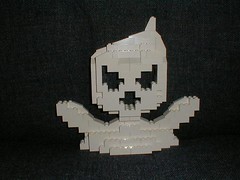
Models built for display in my front window for Halloween. Click the big picture to go to the set page on Flickr, or click on an individual photo. Or, you can view a slideshow of the photos. |
           |
Building a brighter tomorrow with LEGO® bricks

LEGO Models that I have created
Another repost from 2001.
|
Models built for display in my front window for Halloween. Click the big picture to go to the set page on Flickr, or click on an individual photo. Or, you can view a slideshow of the photos. |
|
These were some of the first LEGO models I made as an adult, which I first posted on my old site in 2001.
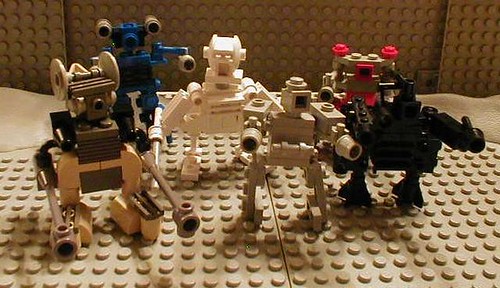
These little guys are miniature robots or mecha, made as an experiment in getting new uses from some rather specialized parts.
This was the first LEGO model I ever posted about online, on my old personal blog.
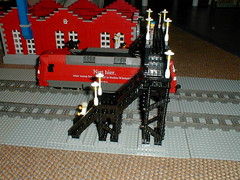
Unlike the rest of my models, this was not built using my own LEGO collection. During a trip to Germany in August 2001, I visited with some German LEGO fans at the home of Holger “HoMa” Matthes in Mönchengladbach, and we built some accessories for their train layout. I built this pedestrian bridge.
Continue reading “September 25, 2001: Pedestrian Bridge”
Recently I posted about some little houses that I had built for the BayLTC train shows. The photos for that are on Flickr, but I wanted to also publish them on Brickshelf which I now have done.
In addition, you can find LDraw instructions for each of the three houses should you be interested in building them yourself. Here are direct links to the building instructions:
Each one is published under a Creative Commons Attribution-Share Alike 3.0 United States License so you are basically free to do whatever you want with it as long as you give me credit. Enjoy!
I built a trio of small houses (16×16 stud footprint) as practice in building in different architectural styles with LEGO.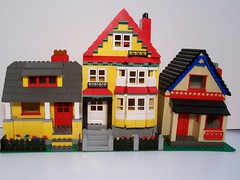 There is a Victorian with bay window, a house with a dormer window in the roof, and a steeply-roofed house.
They’re all a bit too small to be realistic, even by LEGO standards, so I am planning to scrap them and try to build some new houses on a 32×32 footprint. Stay tuned.
View all the pics on flickr (slideshow) or just click the photo on the right.
Update 30-May-2007: Photos and LDraw instructions are now available on Brickshelf.[tags]lego,town,architecture,house[/tags]
I keep building stuff and using it in BayLTC displays but not posting them online!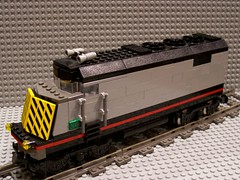 Here’s another example. This locomotive was built a few years ago, not long after I first got the Super Chief, which sadly has long been discontinued. Like the Super Chief, the top lifts off and it has a control cab with prime mover motor modeled inside. I also added a head-end unit.
Key features I’m particularly proud of are the cockpit windows (mounted on plate hinges) and cooling fans (made from 4×4 turntables, taken apart – the base is mounted on the top of the roof, and the top of the turntable is placed underneath to represent intakes). The nose is also mounted at a difficult angle; this is achieved by a combination of hinge elements.
The color scheme is based on the Caltrain commuter trains which run between San Francisco and San Jose, CA. The exterior detailing is minimal, and not terribly accurate (for one thing, the real thing has red and white stripes on the nose, not yellow and black), but at most of our train shows people have immediately recognized it as a Caltrain so I consider it a success.
I brought in some LEGO models to show off in my office at Oracle.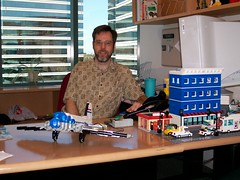 Click the image to view the photoset on Flickr or view a slideshow.
On display is my DC-3 and some office buildings which were featured in the BayLUG "downtown" store window display at the LEGO store recently.
My coworkers have enjoyed the display a lot. All the comments I have had have been positive. I’m surprised to see that most of them think that the models are from kits, rather than my own design, and once I explain that they are generally very impressed.
My plan is to periodically rotate the display, most likely in sync with the BayLUG show schedule. Have you ever brought LEGO to work? What was your coworkers’ reaction?
[tags]lego,office,atwork[/tags]
In honor of Hallowe’en I present this vignette.
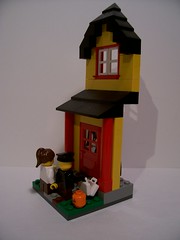
This was actually first mentioned in an earlier blog entry about the October 2006 BayLUG meeting. I entered it into the club building contest which had a theme of “harvest.” Get it? Harvest of souls? I know, it’s macabre and tasteless. Sorry, but my mind just works that way sometimes.
Anyway, it features two kids innocently trick-or-treating. There’s a girl dressed as a doctor and a boy dressed as a policeman. But no medical skills or law enforcement training can stop the Grim Reaper!!
View all the pics by clicking the above image, or click to view the photos on Flickr (slideshow) or on Brickshelf.
[tags]lego,vignette,halloween,death,grimreaper,trickortreat,house[/tags]
When my father left the Navy and joined United Air Lines in the late 1950’s, he flew this plane, the DC-3.
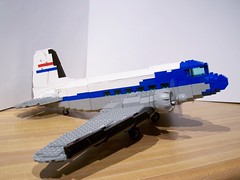
Like my Lunar Mobile Lounge, this has been at several BayLUG meetings, and now I am finally posting about it here.
Also like that model, it is motorized. There are two motors, located in the fuselage: one which powers the propellers and the other which makes the landing gear go up and down. There is a battery box in the fuselage that powers the propellers, and a wire coming out of the entry door leading to a battery box that controls the landing gear. In both cases, a Technic axle passes through the fuselage and the base of each wing. For the props, there are bevel gears in each engine which drive the propshafts. For the landing gear, the axle is mounted directly to the mechanism. A roof panel is removable to view the mechanism inside. Here’s a video I made to illustrate how it works (it’s also available as a QuickTime movie on Brickshelf):
There are other parts that move as well: the ailerons, elevators, and rudder are all freely hinged. Oh, and the wheels rotate :-) The wings and vertical tail can be removed easily for storage and transportation.
The fuselage is designed using half-stud offsets to achieve the desired shape. This means the walls are very fragile as they cannot be properly interconnected.
On the leading edge of each wing are “de-icing boots” which are made of rubber in the real plane. These are modeled using a curved brick that I got at LEGOLAND California in their “build it and buy it” area in 2003. I don’t know if they were ever part of an official LEGO set, but I never saw them anywhere else. It’s the same shape as the trans-light-blue spotlights in the Soccer sets. These “boots” are attached at an angle using plate hinges and plates, and have half-stud offsets to follow the desired wing angle.
Overall this was an interesting experiment in half-stud offsets and integrating a Technic mechanism into a realistic looking model. I learned a lot making this and hope you enjoy it.
Click the photo above to see more, or click to look on Flickr (slideshow) or on Brickshelf.
My newest Space creation is the Lunar Mobile Lounge which has actually been at several BayLUG meetings, even though I never posted about it here.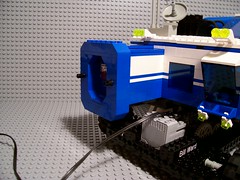
The concept is based on the “mobile lounges” at Dulles (Washington, D.C.) International Airport, which ferry passengers from one terminal to another. However in this case, they ferry people to their waiting spacecraft which landed nearby. Since most spacecraft that people build out of LEGO don’t have wheels, it would be hard for them to dock to the moonbase – it would require some very high-precision flying to land right at a moonbase connector! Therefore I felt there was a need to be able to carry people to and from spacecraft.
Since the spacecraft might have doors that vary in height, I used a scissor lift mechanism to allow this vehicle to raise and lower the passenger compartment – something the Dulles lounges also can do – to match whatever height is needed. You might remember I asked back in March about ways to do this – I ended up using a worm gear to drive, through a short geartrain, a spool that would wind up a string that was attached to the moving leg of the scissor lift.
The vehicle is equipped with an airlock which includes the moonbase connector. The airlock has two doors to the outside – the moonbase connector and a door with stairs leading to the ground (when the vehicle is lowered all the way, that is). There is one interior door, a sliding door which connects the passenger area with the airlock. On the roof you can see the plumbing for the airlock mechanism – hoses and compressors and a big tank for air which are used to alternately drain and fill the air in the airlock and passenger areas. On the underside of the roof are the vents for taking air in and out of these areas.
Click the photo above to see more, or click to look on Flickr (slideshow) or on Brickshelf (pending moderation).[tags]lego,space,moonbase[/tags]