Archive for the ‘How To’ Category

Washing LEGO

Thursday, March 18th, 2010

This is how I wash LEGO parts… how do you do it?

I’ve tried a few approaches.  The laundry washing machine (in a mesh bag) worked fairly well, but I think a few bits got loose and got in the drain so I stopped doing that.  The dishwasher (mesh bag in the top rack) also works OK, but I think it gets too hot in there – I had some warped bricks from the heat.  Handwashing seems the safest, to ensure I don’t lose any parts down the drain or have them melted.  If the water is cool enough to not damage my hands, it’s cool enough to not damage the bricks.

I always wash used bricks when I get them, and also any model that has been on display for any length of time tends to gather dust.  I’m very allergic to dust, and I live with someone who’s very allergic to animal dander, so I need to keep my collection clean.

Anyway, here’s the four step process I use to wash bricks.  Please post in the comments if you’ve found a better way or have any war stories about dirty bricks….

1. Soak in soapy water.  I use All Free/Clear laundry soap – I figure if it’s good for synthetic fabrics it should be good for plastic bricks.

2. Transfer to mesh bag and rinse in bathtub.  I had to do this in three batches, I had so many dirty bricks.

3. Use laundry basket, lined with towel, to carry to living room.

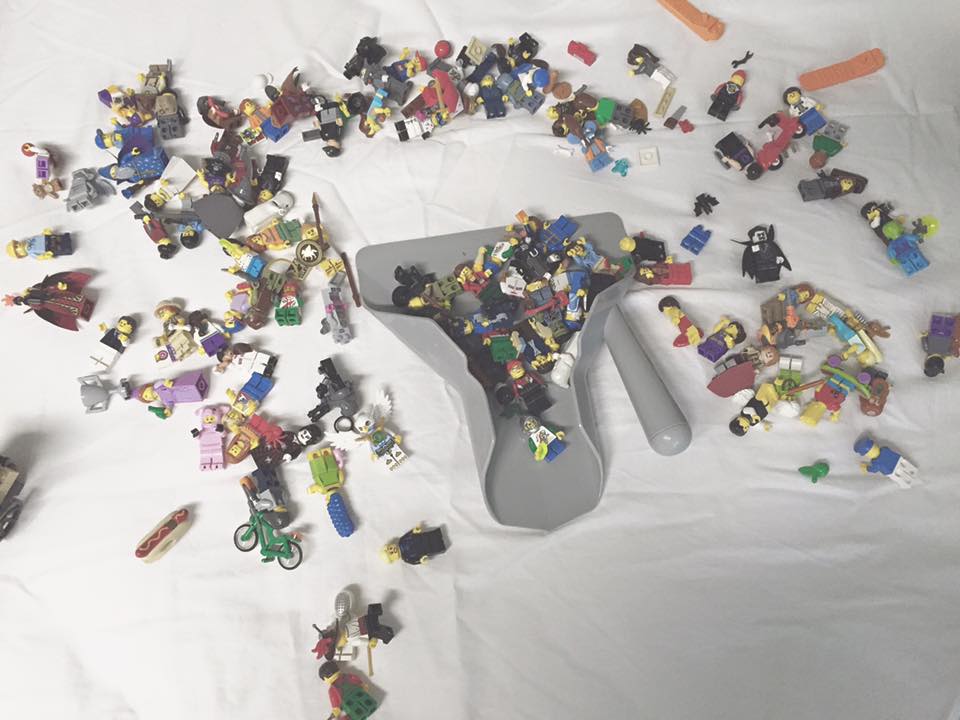
4. Dump out on towels on living room floor, with fan blowing on them.  Luckily I live in coastal California, so the humidity is low and they actually get dry this way.  I’ll stir them periodically, but they’ll be dry enough to sort and put away in a day or two.

Anyone want to come over and help me sort?  I’ll give you free pizza!

The Unofficial LEGO Advanced Building Techniques Guide

Tuesday, February 20th, 2007

Didier Enjary of FreeLUG (French LEGO users group) has compiled a great guide to advanced LEGO construction techniques. It explains in great detail the geometry of LEGO bricks, and how to fit them together to achieve some great effects. The focus is mainly on SNOT (Studs Not On Top) construction, and how to achieve various offsets of fractional brick widths. There are some very inspiring ideas which can improve anyone’s LEGO skills.

You can access the document (it’s a PDF file to be downloaded) on the FreeLUG site and/or read the thread on LUGNET.

Technorati Tags: , , ,

Scissor Lift in Technic?

Friday, March 3rd, 2006

Have you ever tried building a scissor lift in LEGO? I’m working on a project that calls for that kind of mechanism to lift it up, like those food service trucks at the airport. It is based on an “X” shaped arrangement, which, like the two parts of a scissors pivot at the middle. By bringing together the two bottom (or top) ends, the top is lifted into the air.

The approach I took was to use Technic worm gears (like a screw) with a rack gear on it. By turning the worm gears the rack gear should move along its length, which moves the two bottom ends together, elevating the top. The problem is that LEGO gears just aren’t up to the load this places on them, and the teeth skip. I motorized it, gearing down the motor to get more torque, but the gears would rather skip than lift the weight.

Has anyone out there successfully built this kind of scissor lift mechanism in LEGO to lift a nontrivial weight? If so please comment below or email me any tips you may have. Thanks!

P.S.: Sorry for the gap in posts – I’ve been sick with a bad cold for a week or so…

Technorati Tags: , , ,

Keeping Bricks Together

Sunday, January 1st, 2006

I recently got an email from someone out of the blue who said that her son was having trouble with his LEGO models falling apart, and asking about using glue. This entry is based on my reply to her, since I figured that others might have the same concern…

LEGO brand models don’t usually have that problem, but the other brands like Mega Blox often do. Of course since they are only held together by friction it is possible for them to fall apart. When that happens there are two choices: put them back together, or take them completely apart and build something else.

Some people view LEGO as just a model you can build from the instructions. But it can be so much more than that. Ever since I was your son’s age, I have always taken the attitude that LEGO’s instructions are a good way to get started, and that you can learn good techniques from them, but the true power of LEGO comes when you design your own things.

Now a seven-year-old can’t be expected to build the kinds of sophisticated models that adults make, but there’s a lot he can do if he’s encouraged to invent his own spacecraft, houses, animals, or whatever. So rather than thinking of a broken LEGO model as a source of frustration, try to think of it as an opportunity to create
something new and different!

But if you really want to glue them, there are certain types of glue that work better than others. I’ve never done it (in fact, most LEGO fans that I know would never glue, paint, or cut their bricks), but another adult LEGO sculptor I know has: Eric Harshbarger. According to his FAQ he uses “Oatey, All Purpose” glue. If you try it, be sure to use good ventilation!!!

Technorati Tags: